Build vs Buy: Choosing Custom Software That Scales
 Serve Innovate
8 min read
Serve Innovate
8 min read
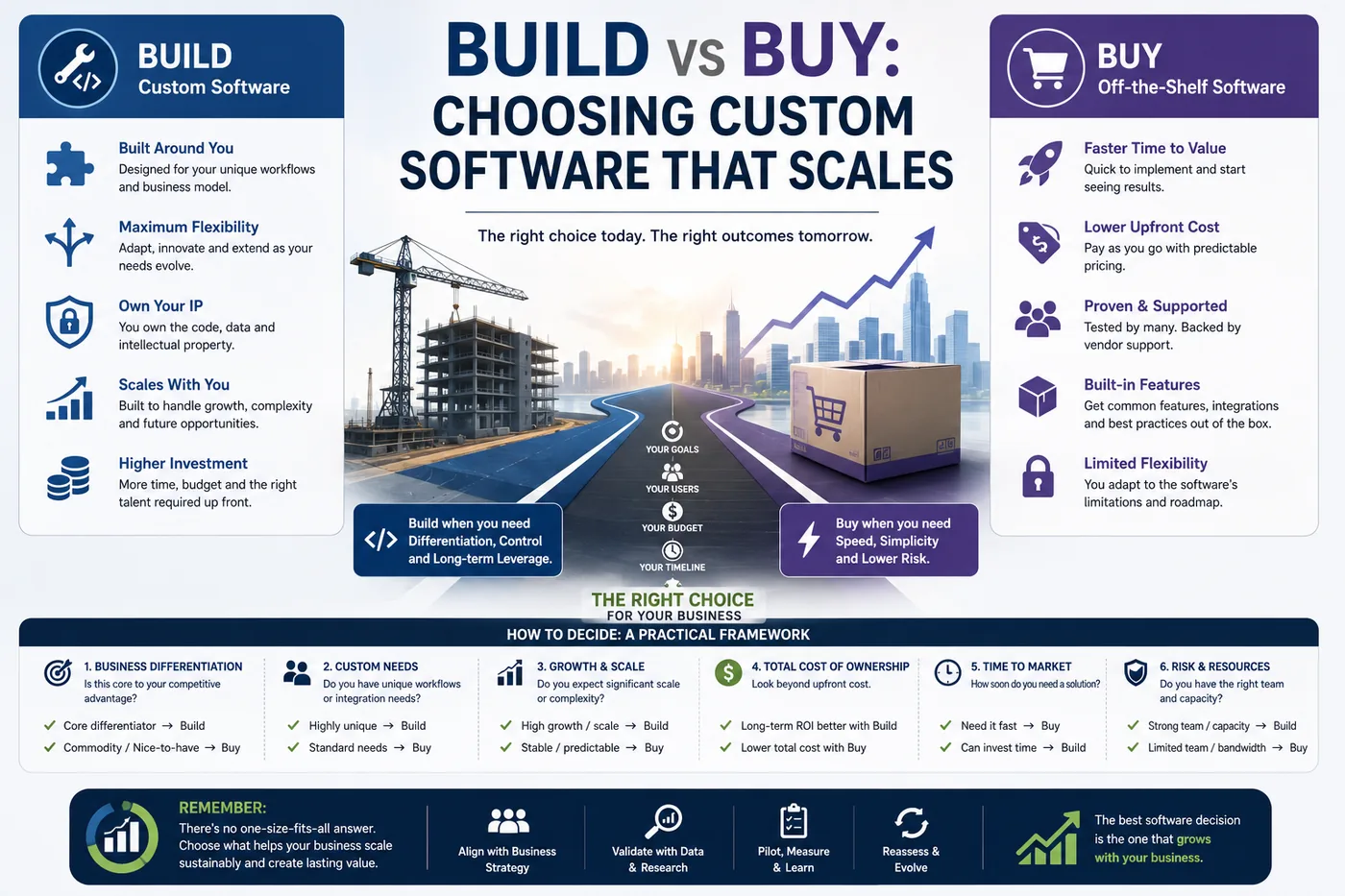
The build-versus-buy decision is usually framed as a cost comparison. It is really a question about differentiation: does this system need to work the way your business works, or does your business simply need the system to work?
Start with a bias toward buying
For any capability that is not a competitive differentiator, off-the-shelf software wins on almost every axis: you get years of accumulated edge-case handling, someone else's security team, someone else's compliance certifications, and no maintenance burden. Accounting, payroll, helpdesk ticketing, email marketing, applicant tracking — these are solved problems, and building them yourself means paying to reinvent something you cannot beat.
The honest cost of a custom build is not the initial project. It is that project plus the next five years of maintenance, security patching, dependency upgrades, support, and the institutional knowledge risk when whoever built it leaves.
Scoping a build? See our custom software development services.
When building is the right call
Custom development earns its cost when at least one of these is true:
- The process is your advantage. If the way you route jobs, price work, or manage inventory is why customers choose you, forcing it into someone else's workflow throws away the advantage.
- The integration burden exceeds the build. When five off-the-shelf tools need seven brittle integrations and a full-time person maintaining them, one system that does the job is often cheaper and considerably more reliable.
- Licensing scales worse than engineering. Per-seat pricing that grows linearly with headcount can overtake a fixed build cost surprisingly quickly. Model it over five years, not one.
- Data ownership or residency is non-negotiable. Some regulatory positions simply cannot be satisfied by a vendor's architecture.
Buy your commodity capabilities. Build the thing that would be embarrassing to explain to a competitor.
The hybrid pattern that usually wins
The strongest architecture is rarely all-or-nothing. Buy the commodity systems of record, then build a thin, well-designed layer that orchestrates them and encodes your actual process. You get the vendor's reliability underneath and your own logic where it differentiates — and you keep the ability to swap a vendor without rewriting the business.
This only works if the integration layer is designed rather than accumulated. A queue, idempotent handlers, and an explicit data-ownership map per entity are the difference between a durable layer and a pile of scheduled scripts nobody dares touch.
Architecting a build that ages well
- Model the domain before choosing the stack. Framework choices are reversible in a way that a wrong data model is not.
- Keep business logic out of the UI and out of the database. Logic in either place is logic you cannot test cheaply or reuse from a second client.
- Design the API first, even for a monolith. A clean internal contract is what makes the mobile app, the partner integration and the eventual service extraction possible later.
- Instrument from day one. Structured logging, error tracking and basic metrics cost hours at the start and save weeks in year two.
- Automate deployment before the second developer joins. Manual deploys are the most reliable source of production incidents in small teams.
- Write down the decisions. A short architecture decision record for each significant choice preserves the reasoning long after the reasoners have moved on.
What "scales" actually means
For most business software, scale is not about millions of concurrent users. It is about whether adding the eleventh workflow, the fourth country, or the second business unit takes a week or a quarter. That kind of scale comes from clear boundaries and a data model that anticipated variation — not from a particular database or a microservice count.
How we scope custom work
We start with a discovery phase that maps the real workflow and challenges every requirement against an off-the-shelf alternative. What survives that challenge is what gets built — architected, tested, documented and handed over with the deployment pipeline, so the system stays yours.
The decision in one line
If a competitor could buy the same capability off the shelf and be at parity with you, buy it. If the capability is the reason you win, build it — and architect it as though you will still be running it in five years, because you will be.
Serve Innovate
We design, build, market and scale digital experiences — e-learning, websites, campaigns and custom software — for organizations that want one accountable partner rather than four.
Work with usFrequently asked
Is custom software more expensive than off-the-shelf?
How long does a custom business application take to build?
What is the total cost of ownership of custom software versus SaaS?
How long does custom software take to build compared to buying?
Can we start with an off-the-shelf product and move to custom later?
What are the signs we have outgrown our current software?
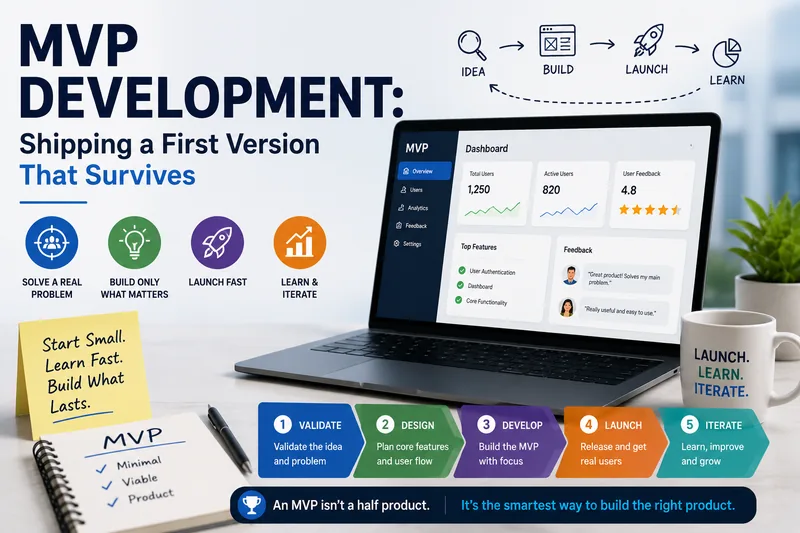
MVP Development: Shipping a First Version That Survives
An MVP is not a cheap version of the real product. It is the smallest thing that produces a trustworthy answer to the riskiest question.
Read article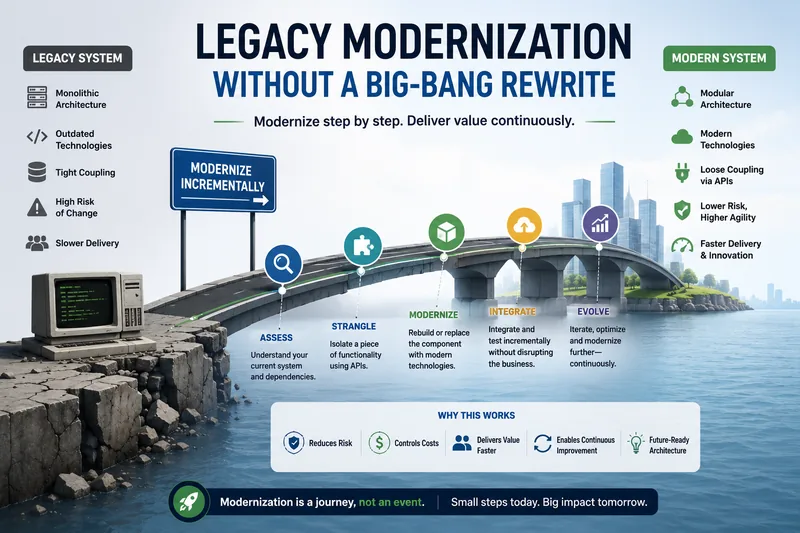
Legacy Modernization Without a Big-Bang Rewrite
Full rewrites of working systems fail at a rate that should have ended the practice. There is a slower route that works.
Read article