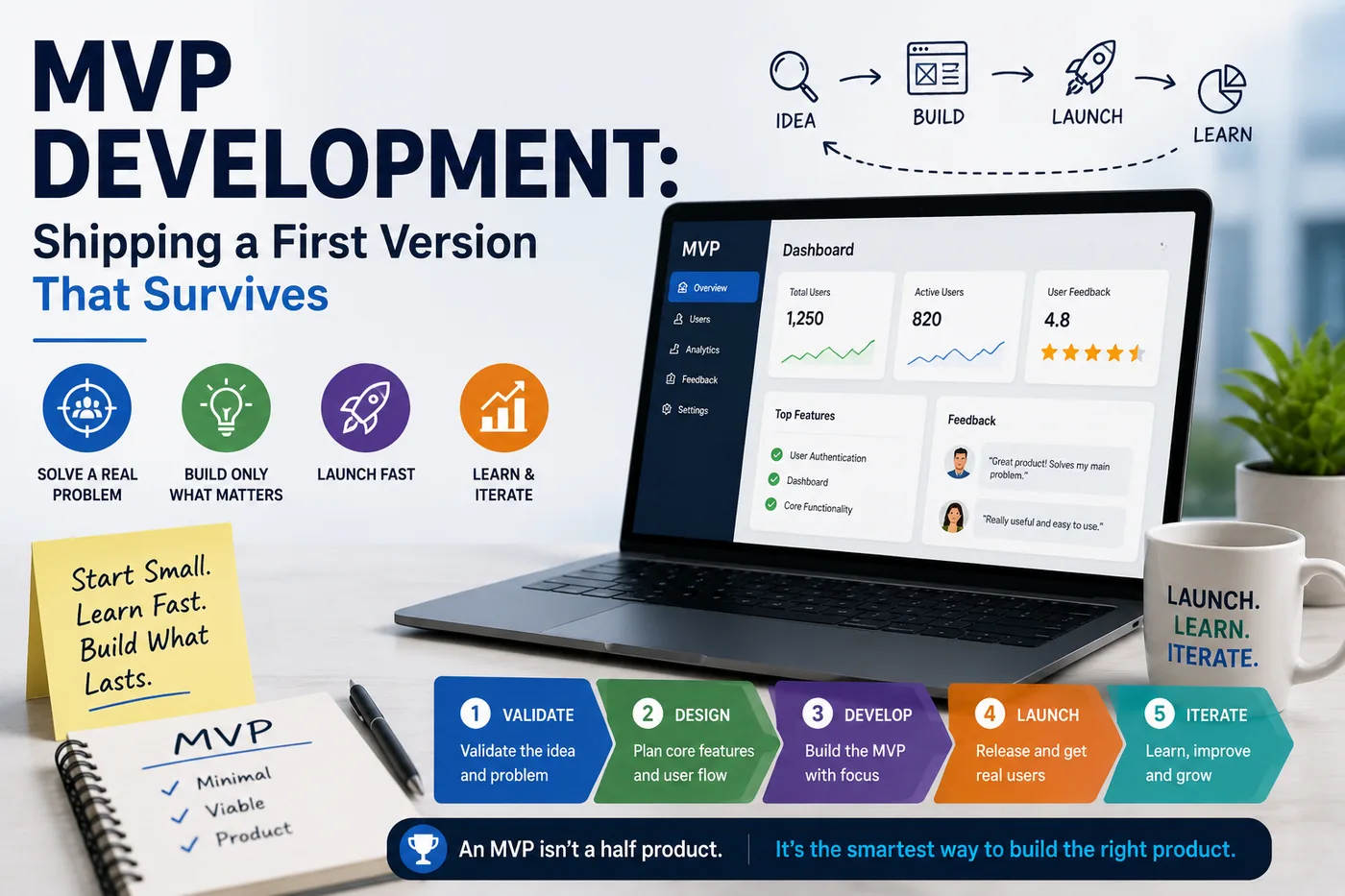
MVP Development: Shipping a First Version That Survives
 Serve Innovate
7 min read
Serve Innovate
7 min read
Most MVPs fail as MVPs rather than as products. They ship a reduced version of everything instead of a complete version of one thing, and consequently produce no clear signal about whether to continue.
Name the riskiest assumption first
Before scoping anything, write down the single assumption that would most damage the business if it turned out to be false. Every MVP decision follows from that sentence.
- “Customers will pay for this.” Then the MVP needs a real payment flow, even if the fulfilment behind it is manual. A signup form measures curiosity, not willingness to pay.
- “We can process this reliably at scale.” Then the MVP is a technical proof with a minimal interface, and polish is irrelevant.
- “Users will change their existing workflow.” Then the MVP must be good enough to be genuinely preferable to the spreadsheet it replaces — which is a higher bar than it sounds, and the reason “minimum” is so often misjudged here.
Different assumptions produce entirely different products of similar cost. Skipping this step is why teams build something that works and still cannot tell whether it worked.
What to cut, and what never to cut
Cutting scope indiscriminately is what produces an unusable MVP. The distinction that matters is between things a first cohort can live without and things that make the result uninterpretable.
Safe to cut:
- Admin interfaces — run operations from the database or a script for the first months.
- Self-service onboarding — onboard early users personally; you learn more from doing it than from analytics.
- Edge-case handling, integrations beyond the first one, and configurability. Hard-code choices a real customer has actually confirmed.
- Native mobile apps, where a responsive web app answers the same question.
Never cut:
- Authentication and authorisation done properly. Retrofitting a permissions model into a live product with real customer data is one of the most expensive rewrites available.
- Data integrity. Corrupted or ambiguous early data destroys the evidence you built the MVP to collect.
- Basic security. A breach in an MVP ends the company as effectively as one in a mature product.
- Instrumentation. An MVP with no analytics produces opinions instead of answers. This is the most commonly and most damagingly cut item.
Deliberate debt versus accidental debt
“We will fix it later” is reasonable when it is a decision and reckless when it is a habit. The workable distinction:
- Deliberate debt is recorded, has a known cost to repay, and is confined to a part of the system that can be replaced independently. Hard-coding a pricing tier in one module is deliberate debt.
- Accidental debt is diffuse: no clear boundaries, business logic entangled with the interface, no tests around the core domain. It cannot be repaid incrementally, only rewritten.
Practically, that means keeping the core domain logic clean and well-tested while permitting the edges to be crude. Payment handling, permissions and the central data model are worth doing properly the first time. The report screen is not.
The MVP question is not “will this scale to a million users”. It is “when the first real customer asks for something, can we change this without rewriting it”.
Timeboxing that changes behaviour
An MVP without a hard deadline expands until it is a full product, at which point the learning it was supposed to produce cheaply has become expensive. Twelve weeks is a defensible default for most B2B products.
The mechanism that makes a timebox work is fixing the date and flexing scope, never the reverse. Weekly, ask one question: if we shipped what exists today, could we answer the risky question? When the answer becomes yes, ship — regardless of the backlog.
Note the corollary. If twelve weeks is genuinely not enough to answer the question, the scope is wrong. Find a narrower question, or a narrower first customer segment.
The month after launch decides everything
Most teams plan the build and not the period that follows, which is where the actual value is realised.
- Talk to every early user individually. At single-digit user counts, conversation beats analytics by a wide margin.
- Watch what they do, not what they request. Feature requests describe an imagined workflow; behaviour describes the real one.
- Resist the first big customer’s roadmap until you know whether their needs are representative. Building a bespoke product for one client while believing you are building a platform is a common and slow-moving failure.
- Decide explicitly: continue, pivot or stop. Write the decision down with the evidence. MVPs that quietly become the product without anyone deciding are how organisations end up maintaining a prototype for five years.
The short version
Name the riskiest assumption, build the smallest thing that tests it honestly, cut interfaces and edge cases freely, and never cut authentication, data integrity or instrumentation.
Timebox it, then spend the following month talking to the people using it. An MVP that produces a clear answer — including a clear no — has done its job.
Serve Innovate
We design, build, market and scale digital experiences — e-learning, websites, campaigns and custom software — for organizations that want one accountable partner rather than four.
Work with usFrequently asked
How long should MVP development take?
What should never be cut from an MVP?
Is an MVP the same as a prototype?
How do you avoid technical debt in an MVP?
What should happen immediately after an MVP launches?
Legacy Modernization Without a Big-Bang Rewrite
Full rewrites of working systems fail at a rate that should have ended the practice. There is a slower route that works.
Read article
Microlearning That Works: Designing Short Courses People Finish
Cutting a two-hour course into twelve ten-minute videos is not microlearning. This is what actually makes short-form corporate training stick.
Read article