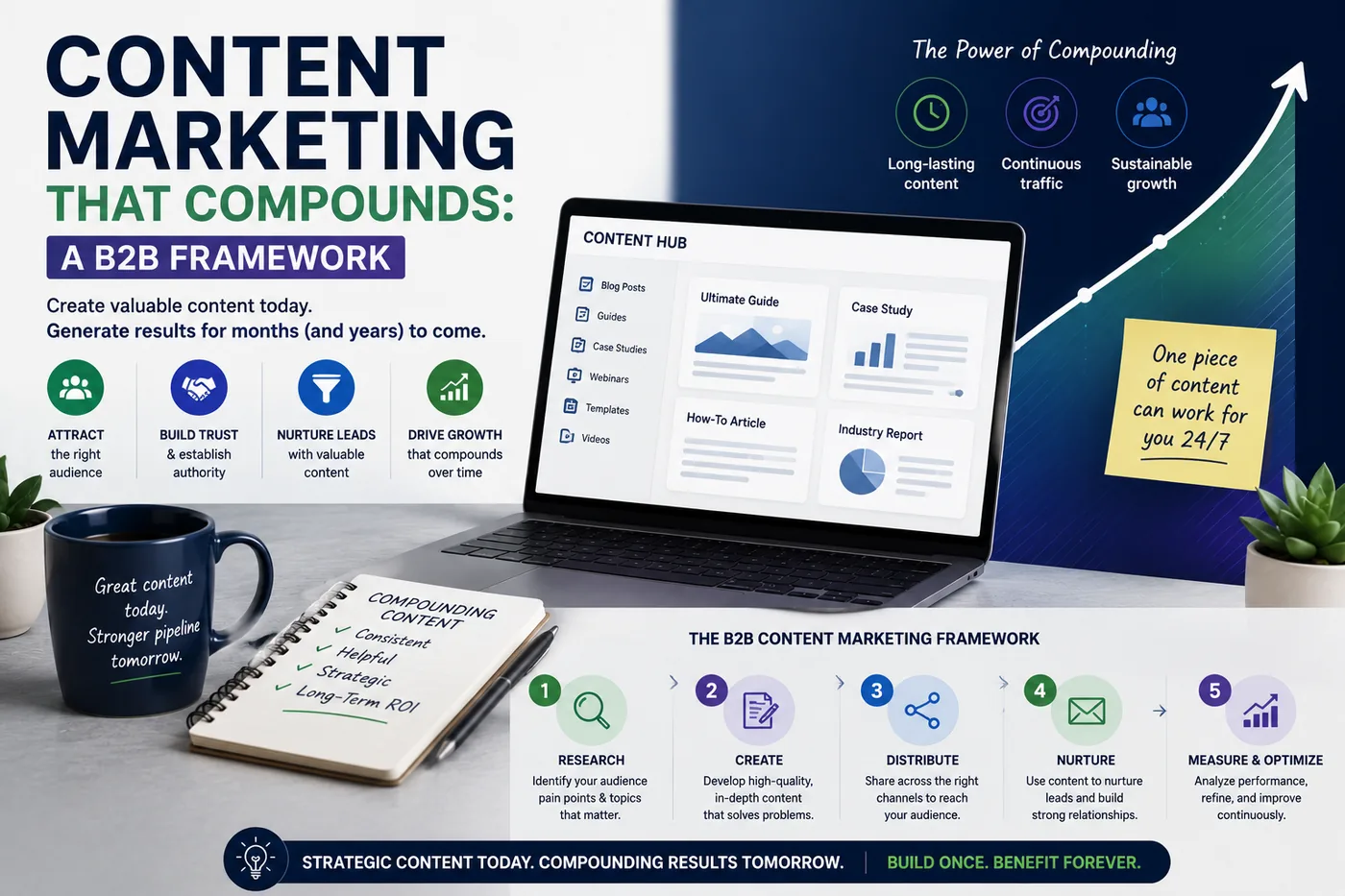
Content Marketing That Compounds: A B2B Framework
 Serve Innovate
7 min read
Serve Innovate
7 min read
Most B2B content programmes fail in a specific, recognisable way: a steady cadence of posts, a slowly rising traffic line, and a pipeline that is entirely unaffected. The problem is almost never volume.
Start from the buying committee, not the keyword tool
A B2B purchase is made by a group, and the members ask different questions. A keyword tool surfaces search volume; it does not tell you which of those questions blocks a decision.
For a typical considered purchase the committee looks like this:
- The practitioner asks how it works, whether it fits the existing stack, and what implementation will demand of their time.
- The economic buyer asks what it costs in total, what the alternatives are, and what happens if the project fails.
- The blocker — legal, security, procurement — asks about compliance, data handling and contractual risk.
- The champion needs material they can forward internally without having to defend it themselves.
Write the actual questions down, in the words each role uses. Twenty to thirty questions is normal, and that list is the content plan. Notably, several of the highest-value ones — pricing structure, implementation effort, security posture — have low search volume and would never surface from a keyword tool. They are also the pages that close deals.
Clusters, not a chronological blog
A reverse-chronological blog is an archive, not an asset. It buries the best material under the most recent and produces no structural signal about what the site is authoritative on.
The alternative is a small number of clusters, each with:
- A pillar page covering a topic comprehensively at the level a buyer needs, kept current and linked from the main navigation.
- Six to twelve supporting pages, each answering one specific question in depth and linking back to the pillar.
- Deliberate internal linking across the cluster, using descriptive anchor text.
Three well-built clusters outperform two hundred unstructured posts, for reasons that are both algorithmic and human: the internal linking concentrates authority, and a buyer landing on any page in the cluster can find the rest.
Depth is a competitive moat; length is not
“Long-form” became a proxy for quality and then a substitute for it. What actually differentiates content in a crowded B2B category is material a competitor cannot cheaply reproduce:
- Original data — your own benchmarks, aggregated anonymised customer results, a survey of your market.
- Specific numbers. “Implementation typically takes six to nine weeks with two people from your side” is more persuasive and more memorable than “fast implementation”.
- Genuine trade-offs, including where you are not the right choice. This is the fastest way to establish credibility and it is what makes a page forwardable inside a prospect’s organisation.
- Worked examples with real constraints rather than idealised scenarios.
If a competitor could publish your article with their logo on it and nothing would look wrong, it is not doing anything for you.
Refresh beats publish
The highest-return activity in a mature content programme is almost always updating existing pages rather than producing new ones. A page ranking fourth that is brought up to date and expanded frequently moves to first — a traffic change no new post is likely to match.
- Audit quarterly for pages ranking between position five and fifteen. These are the ones where improvement produces disproportionate returns.
- Update the substance, not the date. Changing a timestamp without changing the content is transparent and ineffective.
- Consolidate near-duplicates. Three thin posts on overlapping topics compete with each other; merged into one strong page with redirects from the others, they stop.
- Prune content that has no traffic, no links and no strategic purpose. A smaller, stronger site is easier to crawl and easier to navigate.
Metrics that indicate something
Sessions and time-on-page are reported because they are easy, not because they are informative. More useful:
- Assisted conversions by page. Which pages appear in the paths of accounts that became opportunities — regardless of whether they were the last touch.
- Rankings for the committee questions you wrote down, not for generic head terms.
- Sales usage. Which pages does the sales team actually send to prospects? This is the strongest available signal and it costs nothing to collect — ask them.
- Return visitors to the cluster. Repeat visits from the same account during an evaluation is buying behaviour.
Attribution in B2B is imperfect and always will be, given long cycles and multiple stakeholders. Directional signals used consistently beat precise ones nobody trusts.
The short version
Write down the questions your buying committee actually asks, build clusters that answer them thoroughly, include the specifics competitors avoid publishing, and spend more effort improving existing pages than producing new ones.
A programme of thirty deliberate pages, maintained, will outperform three hundred published and abandoned. The compounding comes from maintenance, not from cadence.
Serve Innovate
We design, build, market and scale digital experiences — e-learning, websites, campaigns and custom software — for organizations that want one accountable partner rather than four.
Work with usFrequently asked
How often should a B2B company publish blog content?
What is a topic cluster in content marketing?
How do you measure B2B content marketing ROI?
Should we update old blog posts or write new ones?
Does long-form content rank better?

Local SEO for Indian Businesses: Ranking in Your City
Local search is where intent is highest and competition is most beatable. Most businesses lose it on details that take a week to fix.
Read article
Microlearning That Works: Designing Short Courses People Finish
Cutting a two-hour course into twelve ten-minute videos is not microlearning. This is what actually makes short-form corporate training stick.
Read article