
Microlearning That Works: Designing Short Courses People Finish
 Serve Innovate
7 min read
Serve Innovate
7 min read
Microlearning is the most requested and least understood format in corporate training. Most organizations arrive at it having decided the answer — "make it shorter" — before asking what the learner is actually failing to do.
Microlearning is a scope decision, not a duration
The defining feature of a microlearning module is not that it runs for six minutes. It is that it teaches exactly one thing a learner can act on immediately. Duration is a consequence of that scope, not a target to hit.
This distinction matters because it changes what you cut. Slicing a 90-minute compliance course into fifteen six-minute chapters produces fifteen fragments of a lecture, each of which assumes the fourteen others. Learners still need the full sequence, they have simply lost the thread between the parts. Completion rates go up; capability does not.
A genuine microlearning module answers a question the learner already has, at the moment they have it, and ends when that question is answered.
When short-form is the right answer — and when it is not
Microlearning earns its place in a narrow but common set of situations:
- Procedural refreshers — how to raise a purchase order, how to escalate a safety incident, how to run a specific report.
- Point-of-need support — content the learner searches for while doing the task, not before it.
- Reinforcement after a longer programme — spaced recall of concepts already introduced properly.
- Rapidly changing content — policy or product details that would make a large course obsolete every quarter.
It is the wrong format when the objective requires building a mental model rather than recalling a step. Teaching a new manager how to handle a performance conversation, or an engineer how a system architecture fits together, needs sustained context, worked examples and practice with feedback. Compressing that into fragments does not simplify it — it removes the connective reasoning that made it learnable.
If a learner cannot use what you taught within roughly a week, the format is not the problem. The sequencing is.
How to design a module that gets finished
The structure that consistently works is uncomfortably simple. Four parts, in this order:
- The trigger. Name the real situation in the first ten seconds. "A supplier invoice has arrived without a PO number." Not "In this module we will explore procurement compliance."
- The demonstration. Show the action being performed, in the actual system, at the actual speed. Screen capture beats animation almost every time, because learners recognise the interface they will face.
- The practice. One decision, with consequences. A branching choice, a drag-and-drop sequence, a short simulation — anything that requires the learner to commit before being told the answer.
- The takeaway. A single retrievable artefact: a job aid, a checklist, a one-screen summary they can find again in three weeks without re-watching anything.
Note what is absent — a learning-objectives slide, a welcome screen, a navigation tutorial, and a closing quiz that tests recall of the video rather than capability at the task. Each of those is a completion tax, and in short-form content the tax is proportionally enormous.
Design for the phone, then check the desktop
Most microlearning is consumed on a phone, frequently in the gaps of a working day — between meetings, on a commute, on a shop floor. That has concrete design consequences:
- Text on screen must be legible at arm’s length on a 6-inch display, which in practice means far fewer words than a desktop mock-up suggests.
- Audio cannot be load-bearing. A meaningful share of learners will play the module muted, so captions and on-screen text have to carry the content on their own.
- Interactions need to work with a thumb. Precise drag targets and hover states fail on touch.
- Every module must survive an interruption. If a learner takes a call at minute three, resume state has to bring them back to minute three — not to the start.
Building mobile-first and validating on desktop produces better results than the reverse, because the constraints only run in one direction.
Measuring something more useful than completion
Completion rate is the metric organizations report and the one that tells them least. A 96% completion rate on a mandatory module means the module was mandatory. It is attendance, recorded precisely.
Three measures carry more signal:
- First-attempt success on the practice interaction. If most learners get it right before any instruction, the module is teaching something they already knew. If almost none do, the demonstration is unclear.
- Voluntary re-access. How often learners return to a module after completing it. High re-access on a job-aid module is a success signal — it is being used as reference. High re-access on a concept module usually means the first pass did not land.
- Downstream operational data. Error rates, ticket volumes, time-to-competence for new joiners. Harder to attribute, and the only category that answers whether the training was worth building.
If your LMS can report on the first two, you can iterate meaningfully. xAPI makes the third tractable by letting you record learning events alongside operational ones.
The short version
Microlearning works when it is scoped to one actionable thing, triggered by a real situation, practised rather than watched, and left behind as something retrievable. It fails when it is a long course served in slices.
Before building a library of short modules, spend the time to write down what each one should let a specific person do differently on a specific day. The modules that survive that test are worth building. The rest were a length problem disguised as a learning problem.
Serve Innovate
We design, build, market and scale digital experiences — e-learning, websites, campaigns and custom software — for organizations that want one accountable partner rather than four.
Work with usFrequently asked
How long should a microlearning module be?
Is microlearning effective for compliance training?
What is the difference between microlearning and just shorter videos?
How do you stop microlearning becoming a disconnected content library?
Does microlearning improve knowledge retention?
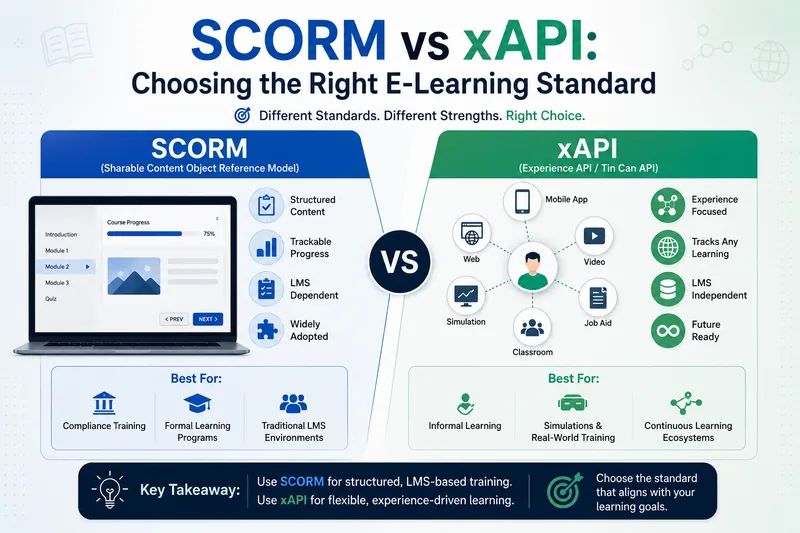
SCORM vs xAPI: Choosing the Right E-Learning Standard
One tracks whether a course was completed. The other tracks what a person actually did. Choosing wrongly costs you either data or years of rework.
Read article
AI in Corporate Training: Practical Uses That Actually Work
Past the demos, a short list of AI applications in L&D genuinely earn their place — and a shorter list quietly create risk.
Read article