SCORM vs xAPI: Choosing the Right E-Learning Standard
 Serve Innovate
8 min read
Serve Innovate
8 min read
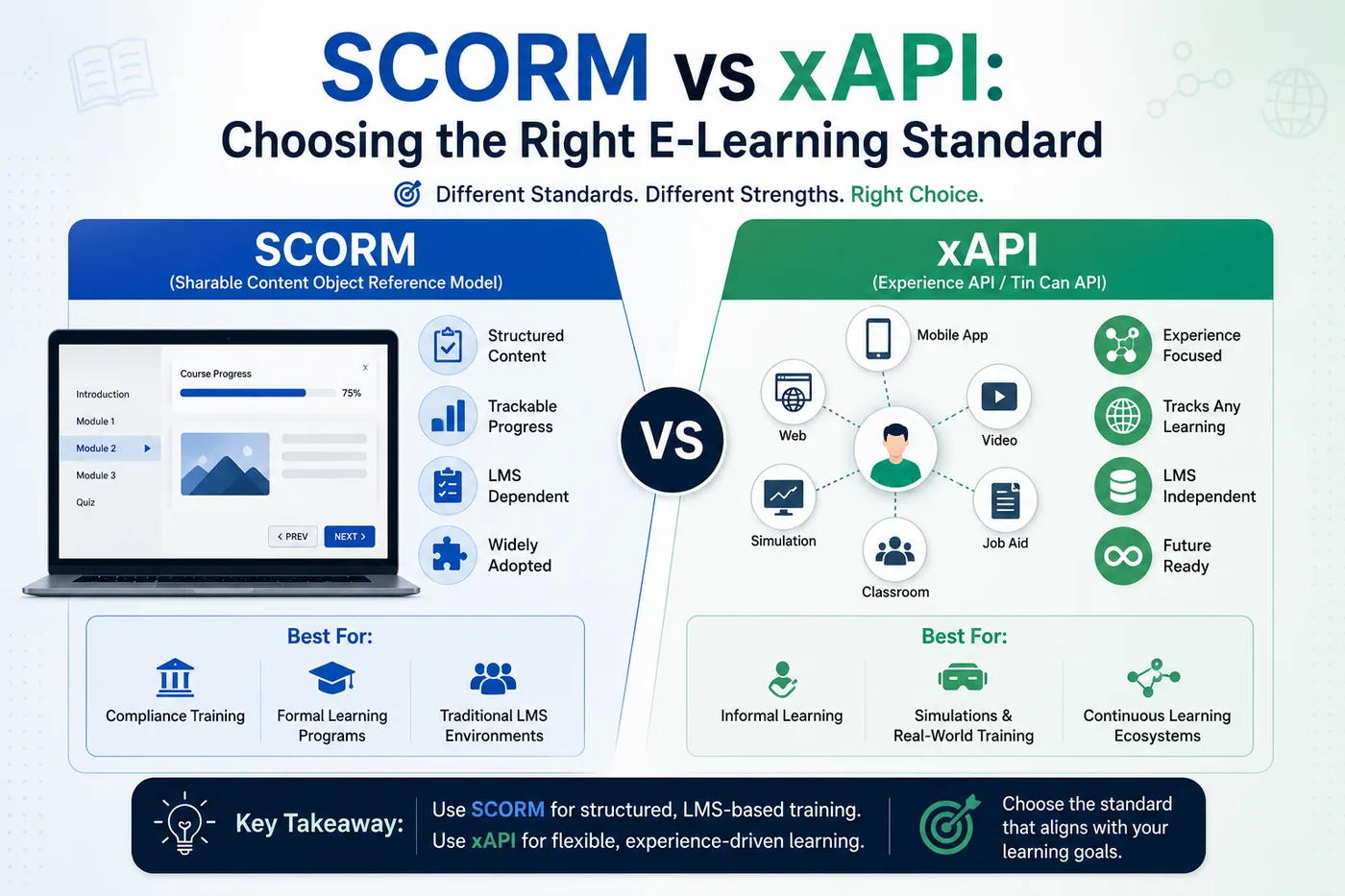
The choice between SCORM and xAPI is usually presented as old versus new. It is more useful to see it as a question of scope: SCORM describes a course, xAPI describes a learner. Which one you need depends entirely on what you intend to do with the data.
What SCORM actually gives you
SCORM — Sharable Content Object Reference Model — solved a real problem in 2001 and still solves it. It is a packaging and communication contract: bundle a course as a zip with a manifest, and any conforming LMS can launch it, track it and report on it.
What it tracks is deliberately narrow. A SCORM package reports completion status, success status, a score, time spent, and a limited bag of interaction data, back to the LMS that launched it. That is genuinely sufficient for a large share of corporate training, where the operational question is "has everyone in scope completed the mandatory module before the audit".
Its constraints are equally definite:
- The content must run inside an LMS, in a browser window the LMS opens. No tracking outside that session.
- Communication uses the browser’s JavaScript API and same-origin rules, which is why cross-domain SCORM hosting is perennially painful.
- SCORM 1.2 caps
cmi.suspend_dataat 4,096 characters — a limit that quietly breaks long branching simulations. - It cannot describe anything that is not a course: a coaching session, a job shadow, a conference, a document read on a phone.
What xAPI changes
xAPI — also called the Experience API or Tin Can — replaces the course-completion model with a statement model. Every recorded event is a sentence: actor, verb, object. "Priya completed Fire Safety Level 2." "Rahul attempted Escalation Simulation." "Aisha read Supplier Onboarding Policy v4."
Those statements go to a Learning Record Store (LRS), which may or may not be part of an LMS. That single architectural change is what unlocks the rest:
- Learning can be recorded from anywhere — a mobile app offline, a simulator, a piece of production software, a physical classroom scanned in later.
- Granularity is yours to choose. You can record every decision inside a branching scenario, not just the final score.
- Data from different systems lands in one place with a common shape, which is what makes correlation with operational metrics possible.
- There is no 4KB ceiling and no requirement to live inside a browser session.
The cost is that xAPI gives you a vocabulary, not a report. SCORM tells the LMS what "complete" means; with xAPI your team decides what to record, what the verbs mean, and what a dashboard should show. That freedom is the feature and the burden.
A decision that takes ten minutes
Work through these in order and stop at the first clear answer.
- Is the only real question "who finished the mandatory course"? Use SCORM. Everything else is over-engineering.
- Does any learning happen outside a browser session your LMS controls — offline mobile, simulators, in-app guidance, classroom? SCORM cannot see it. Use xAPI.
- Do you need to correlate learning with operational outcomes such as error rates, sales figures or safety incidents? xAPI, and budget for the analytics work, which is where the effort actually sits.
- Does your authoring tool or LMS constrain the choice? Most modern authoring tools publish to both. Some older enterprise LMS platforms accept xAPI packages but only store a fraction of the statements. Verify this with a test package before committing — vendor capability sheets are frequently optimistic.
- Are you distributing content to external clients? SCORM 1.2 remains the most universally accepted format. If your courses have to run on customer LMS platforms you do not control, SCORM is still the safe interchange format.
The pragmatic middle: publish both
Most teams do not have to choose once and forever. A common and sensible pattern is to publish content as SCORM for LMS launch and compliance reporting, while the same content also sends xAPI statements to an LRS for the richer behavioural data.
This works because the two standards are not in conflict — cmi5 exists precisely to formalise it, using an LMS to assign and launch content while xAPI carries the tracking. It gives the compliance team the completion report they need and the L&D team the interaction data they want, without maintaining two versions of the course.
The overhead is real but bounded: one additional endpoint to configure, and a decision about which system is authoritative when the two disagree. Decide that before launch, not during an audit.
Migrating without breaking your reporting history
The failure mode in migration is not technical, it is historical. Years of SCORM completion records exist in the LMS, and the audit obligation attached to them does not disappear because a new standard arrived.
- Do not backfill. Converting historical SCORM records into synthetic xAPI statements produces data with a false precision. Keep the old records where they are and set a clean cut-over date.
- Run parallel for one full reporting cycle. If you report quarterly, run both for a quarter and reconcile the numbers. Discrepancies at this stage are almost always definitional — what your LRS counts as "completed" versus what the LMS did.
- Write the verb vocabulary down first. An LRS that has accumulated
completed,finishedandcompleteas three separate verbs is a data-cleaning project nobody scheduled. - Pilot on one course family. Preferably one with a simulation or scenario, since that is where the extra granularity demonstrates value most clearly to stakeholders funding the change.
The short version
SCORM is a mature, universally supported way to answer a narrow question, and for a great many compliance programmes that question is the only one being asked. xAPI answers a much broader set of questions and asks you to build the analytics layer that turns statements into decisions.
Choose SCORM when completion is the outcome. Choose xAPI when behaviour is the outcome and you have someone whose job it is to look at the data. Choosing xAPI without that person produces a very modern, very large store of statements nobody reads.
Serve Innovate
We design, build, market and scale digital experiences — e-learning, websites, campaigns and custom software — for organizations that want one accountable partner rather than four.
Work with usFrequently asked
Is xAPI replacing SCORM?
Do I need a Learning Record Store to use xAPI?
What is cmi5 and how does it relate to xAPI?
Can existing SCORM courses be converted to xAPI?
Which standard should we use for mobile learning?
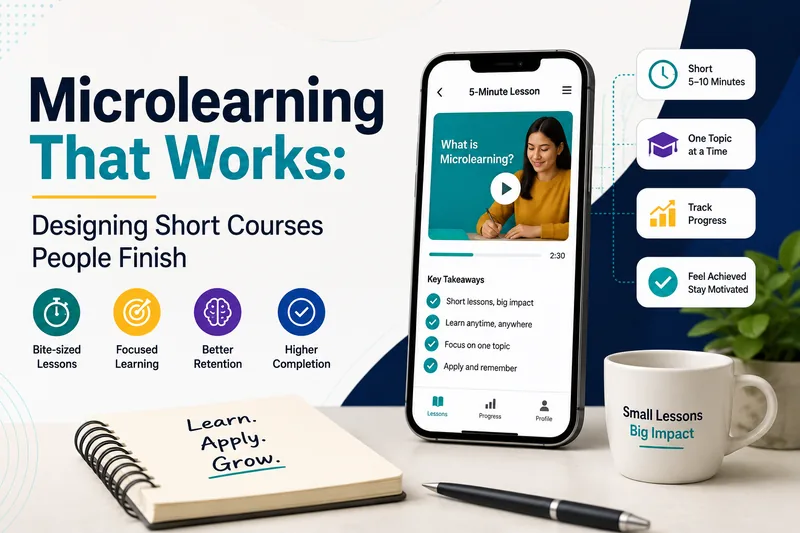
Microlearning That Works: Designing Short Courses People Finish
Cutting a two-hour course into twelve ten-minute videos is not microlearning. This is what actually makes short-form corporate training stick.
Read article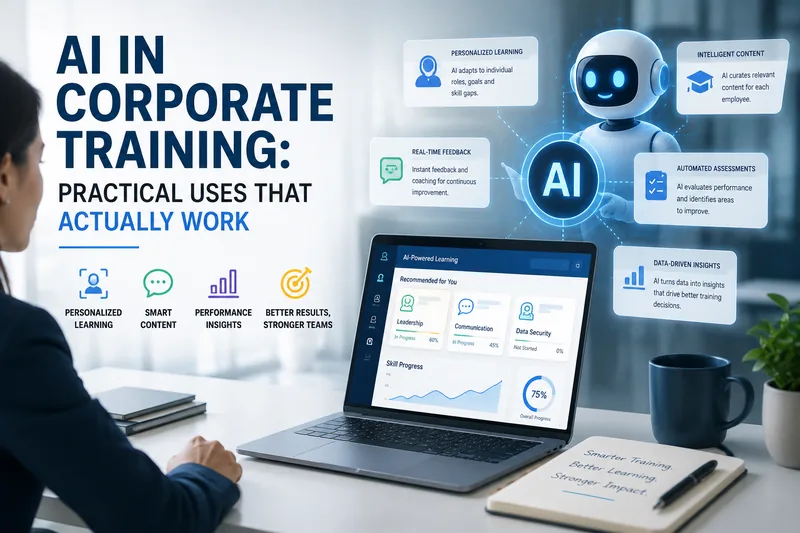
AI in Corporate Training: Practical Uses That Actually Work
Past the demos, a short list of AI applications in L&D genuinely earn their place — and a shorter list quietly create risk.
Read article