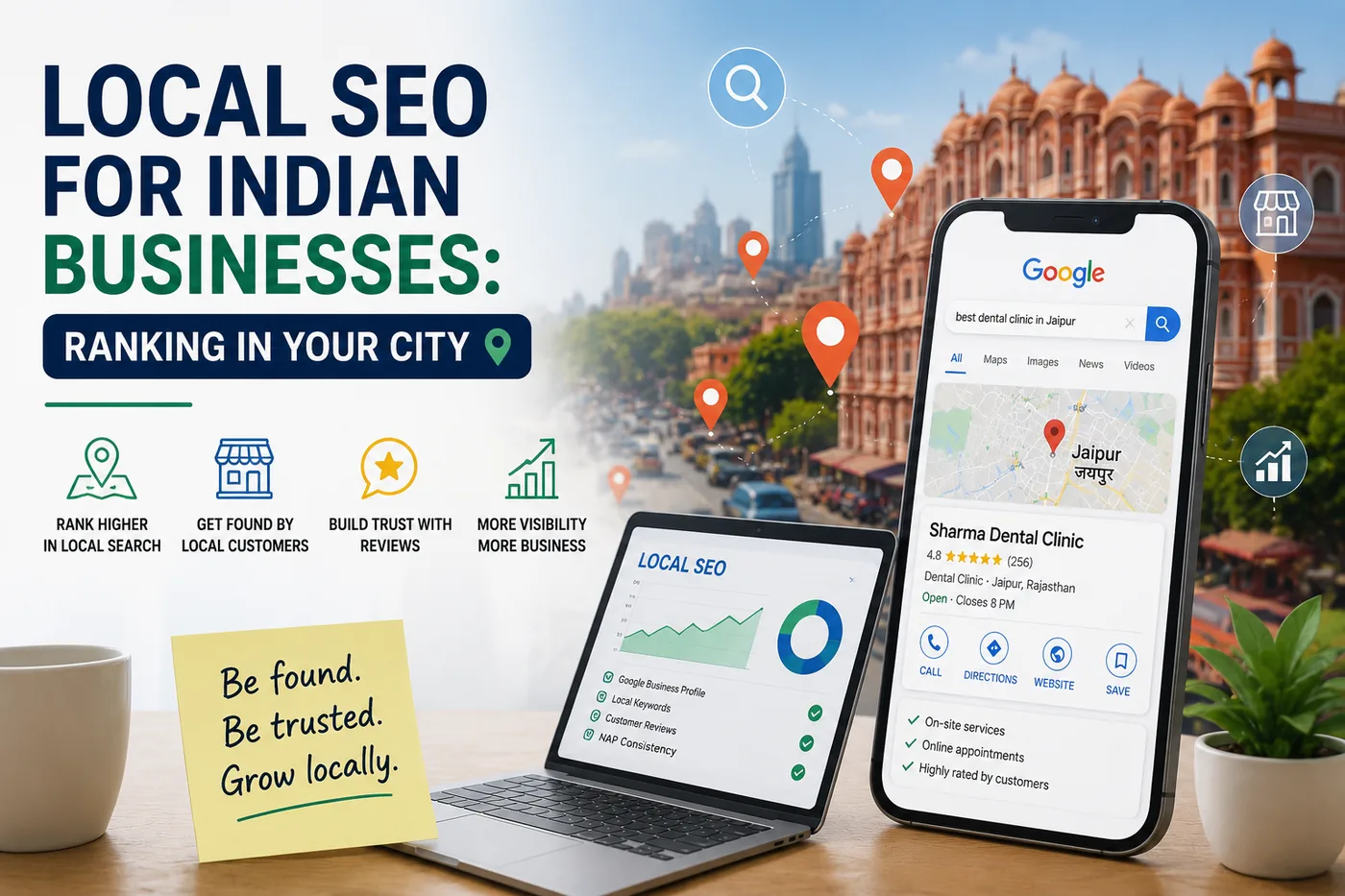
Local SEO for Indian Businesses: Ranking in Your City
 Serve Innovate
8 min read
Serve Innovate
8 min read
Someone searching “interior designer in Gurgaon” is closer to buying than almost any other traffic you can acquire. Local SEO is the discipline of being the obvious answer to that search — and it is decided by a small number of unglamorous details.
Google Business Profile is the ranking asset
For local queries, the map pack sits above the organic results and takes a large share of the clicks. Your Business Profile — not your website — is what ranks there, which makes it the highest-leverage asset in local search.
What measurably affects position:
- Primary category, chosen precisely. This is the single strongest lever. “Interior designer” and “interior architect” return different competitive sets. Check what the businesses currently ranking have selected.
- Complete service and product listings. Profiles with services enumerated rank for more long-tail queries because those listings are matched against query text.
- Accurate hours, including holidays. Profiles marked closed during a search lose placement, and Indian holiday calendars vary enough by state that this is easy to neglect.
- Genuine photographs, added regularly. Recency of photos correlates with engagement, and engagement correlates with placement.
- Q&A actively managed. Anyone can answer a question on your profile. Unmanaged, that space fills with wrong information from strangers.
Two things that do not help: keyword-stuffing the business name, which is a guidelines violation and a common cause of suspension, and creating multiple profiles for one location.
NAP consistency — dull, and decisive
Name, Address and Phone must be byte-identical everywhere they appear: your website, your Business Profile, Justdial, IndiaMART, Sulekha, industry directories, social profiles.
Indian addresses make this harder than in most markets. “Sector 44” and “Sec-44”, “Gurgaon” and “Gurugram”, “Bengaluru” and “Bangalore”, phone numbers with and without +91, a building name included or omitted — each variant reduces confidence that the listings refer to the same business.
- Write the canonical version once, exactly as it should appear, and treat it as fixed.
- Audit every listing you can find, including old ones for a previous office.
- Correct or claim and delete duplicates, prioritising the highest-traffic directories.
- Publish the same string in
LocalBusinessschema on your website.
This is tedious work with no visible output until rankings move, which is precisely why competitors have not done it.
Location pages that are not doorway pages
Businesses serving several cities need a page per city. The failure mode is generating twenty near-identical pages with the city name swapped, which search engines classify as doorway pages and may penalise.
A location page earns its place when it contains information only true of that location:
- Projects, clients or case studies from that city, named.
- The specific team or contact serving it.
- Locality-level detail — neighbourhoods covered, travel or delivery constraints, local regulatory considerations where relevant.
- Reviews from customers in that city.
- Genuinely different photographs.
If you cannot write three paragraphs that would be false for another city, do not create the page. One strong page targeting a region outperforms twelve thin ones.
Reviews: volume, recency, and replies
Reviews influence both ranking and conversion, and the effect decays. Forty reviews from three years ago carries less weight than fifteen from the past quarter.
- Ask systematically — at the point of successful delivery, with a direct link to the review form. A process that depends on someone remembering will not produce a steady flow.
- Never buy reviews. Detection is good, removal is retroactive, and profile suspension is a real outcome.
- Reply to all of them, particularly negative ones. A measured, specific reply to a complaint reads better to prospects than an unbroken wall of five-star ratings, which most readers now discount.
- Watch for review gating. Soliciting only from customers who indicate satisfaction violates Google’s policy.
Five mistakes that quietly suppress local rankings
- Hiding the address because the business runs from home. Service-area businesses can hide it deliberately in the profile settings — but omitting it inconsistently across directories creates conflicting data.
- A call-tracking number on the website that differs from the profile number, which breaks NAP consistency. Use dynamic number insertion that preserves the canonical number in the markup.
- Ignoring Apple Maps and Bing Places. Smaller in volume, close to zero effort, and they feed other services.
- No embedded map or local schema on the contact page.
- Treating local as a one-time setup. Profiles decay: hours drift, categories change, competitors add services. A quarterly review is the minimum sustainable cadence.
The short version
Choose the primary category precisely, make NAP identical everywhere, build location pages only where you have location-specific substance, and generate reviews as a routine rather than a campaign.
None of this is sophisticated. Its value comes from the fact that it is boring enough that most competitors in most Indian cities have not finished it.
Serve Innovate
We design, build, market and scale digital experiences — e-learning, websites, campaigns and custom software — for organizations that want one accountable partner rather than four.
Work with usFrequently asked
How long does local SEO take to show results?
Do I need a physical address for local SEO in India?
How many Google reviews do I need to rank in the map pack?
Should I create a separate page for every city I serve?
Does keyword-stuffing the business name help local rankings?

Content Marketing That Compounds: A B2B Framework
Publishing more is not a strategy. A small set of pages that answer buying questions properly will outperform a blog nobody reads.
Read article
Microlearning That Works: Designing Short Courses People Finish
Cutting a two-hour course into twelve ten-minute videos is not microlearning. This is what actually makes short-form corporate training stick.
Read article